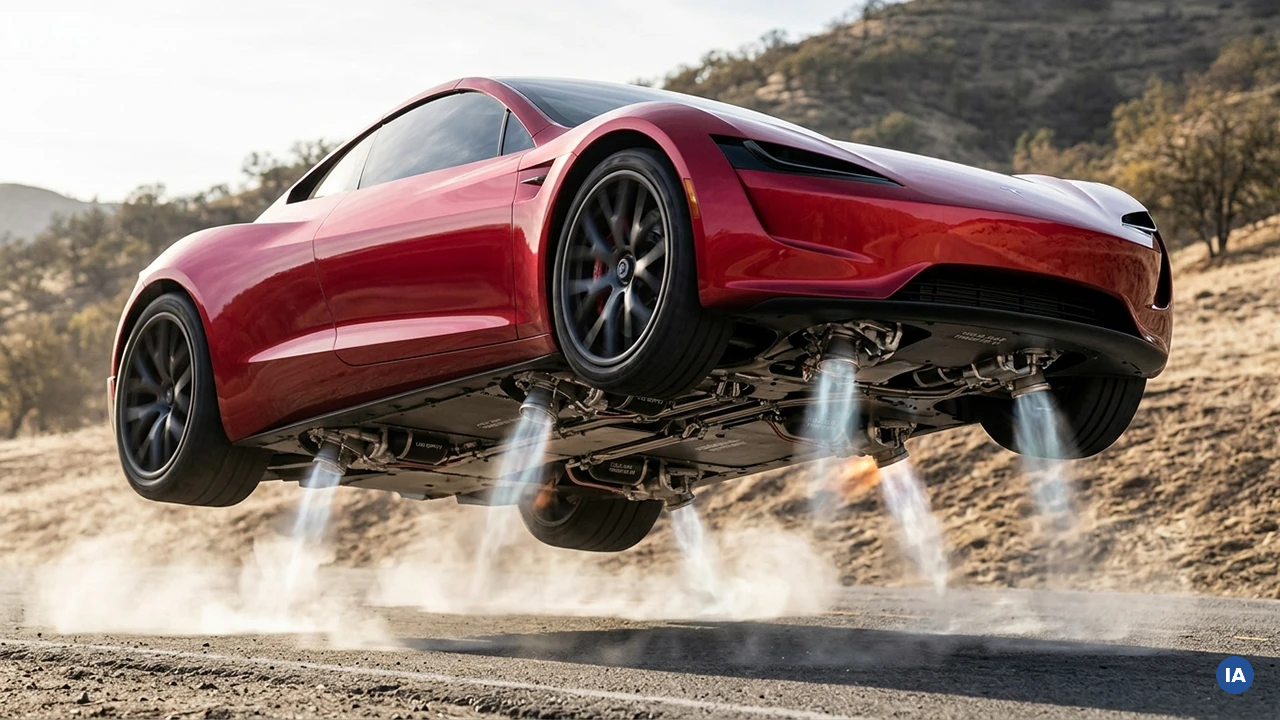
A dramatic demonstration involving Tesla’s next-generation Roadster has revived debate about whether flying cars are becoming practical. Reports describe a brief lift-off using experimental hardware associated with compressed-gas thrusters. That is not the same as a road-legal car that can routinely take off, fly through traffic and land like an aircraft.
How could the Roadster appear to fly?
Coverage of the demonstration describes experimental propulsion or lift hardware, including compressed-gas thrusters. Such a setup would be very different from conventional automotive powertrains and would require careful engineering, controls and safety validation. Publicly available information does not establish that the vehicle is certified for everyday flight.
Is it a flying car?
The phrase “flying car” can be used loosely for a vehicle that briefly lifts off during a controlled demonstration. A practical flying vehicle would need to meet aviation safety requirements, demonstrate reliable take-off and landing, and operate within a regulated airspace system. A spectacular demonstration alone does not establish those capabilities.
Price and launch timeline
Reports have pointed to a future production target, but exact pricing, final specifications and a firm customer-delivery date should be treated as unconfirmed until Tesla publishes definitive details. The Roadster programme has faced repeated timeline changes in the past.
What buyers should watch
Key questions include whether the flight hardware will be offered to customers, what safety certification is required, how range and performance are affected, and whether the final vehicle can be used legally on public roads. Until these points are clarified, the Roadster’s flying capability is best described as experimental.
Bottom line: The demonstration is attention-grabbing, but it should not be read as proof that fully functional flying cars are already available for ordinary consumers.