
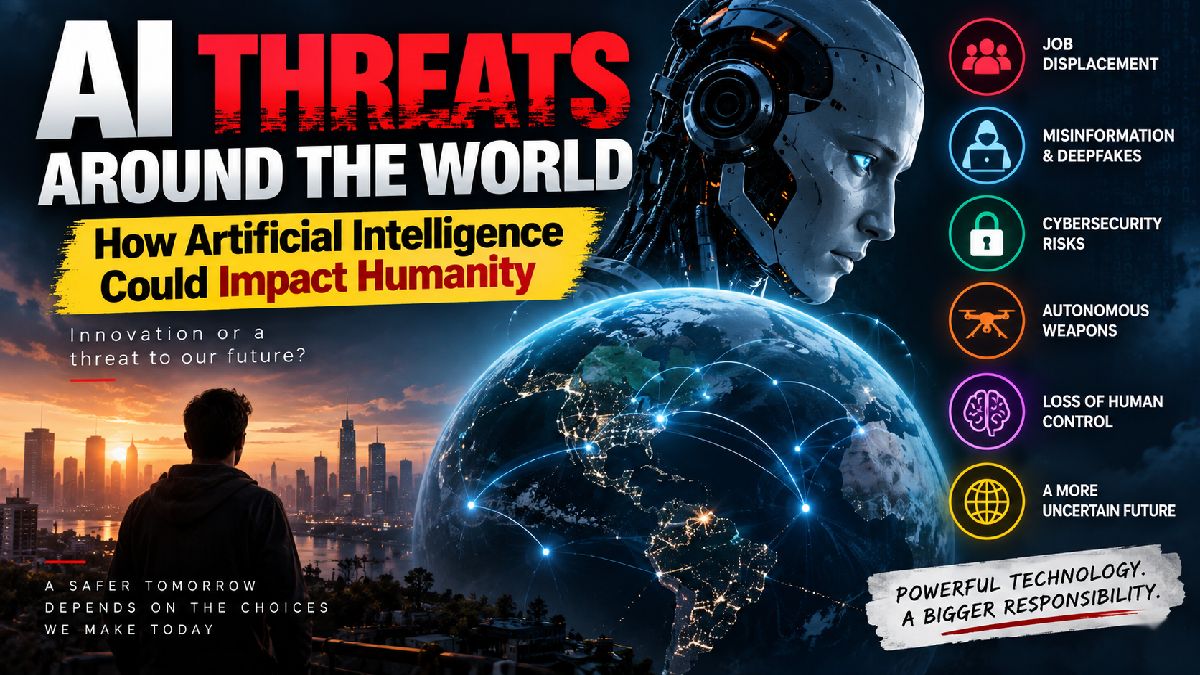
Artificial intelligence (AI) is rapidly transforming healthcare, education, finance, manufacturing, communication and entertainment. While the technology offers enormous benefits, its rapid development has also raised concerns about job displacement, misinformation, cybersecurity, autonomous systems and the misuse of powerful AI tools.
The debate is no longer simply about whether AI will change society. Governments, researchers and technology companies are increasingly discussing how to ensure that AI develops in ways that remain safe, accountable and beneficial to people.
AI and the Threat of Job Displacement
One of the most immediate concerns surrounding AI is its impact on employment. Generative AI can already perform tasks involving writing, coding, image creation, data analysis and customer support.
The World Economic Forum’s Future of Jobs Report 2025 estimates that technological changes, including AI and information processing technologies, could create millions of jobs while also displacing others by 2030. The report projects significant workforce disruption as companies adopt new technologies.
However, AI is also expected to create new roles and increase demand for skills related to technology, data and human-AI collaboration. The impact is therefore likely to vary considerably across industries and occupations.
Misinformation and Deepfakes
Another major concern is the ability of AI to generate convincing fake images, videos, audio and text. Deepfake technology can be used to impersonate individuals or manufacture events that never happened.
This creates challenges for journalism, elections, businesses and ordinary internet users. As synthetic media becomes increasingly realistic, verifying the authenticity and source of digital information could become more difficult.
Cybersecurity Risks
AI can also be misused for cyberattacks. Automated systems can potentially help criminals generate convincing phishing messages, identify vulnerabilities and scale fraudulent activity.
At the same time, cybersecurity professionals are using AI defensively to detect unusual activity, identify threats and respond more quickly to attacks. This has created an ongoing race between attackers and defenders.
Autonomous Weapons and Global Security
The use of AI in military systems has generated another area of international concern. Autonomous weapons could potentially identify and engage targets with varying degrees of human involvement.
Governments and international organisations have consequently debated whether additional rules are needed to ensure meaningful human control over military applications of AI.
Could AI Become a Threat to Humanity?
Some AI researchers and technology leaders have warned about longer-term risks from increasingly capable AI systems. These concerns include the possibility that highly autonomous systems could behave in unexpected ways or be deployed irresponsibly.
At present, many of the most extreme scenarios remain hypothetical. There is no established evidence that today’s AI systems are independently seeking control over humanity. The more immediate risks involve human misuse, unreliable outputs, discrimination, privacy violations, misinformation and inadequate oversight.
The Need for Responsible AI
Artificial intelligence itself is neither inherently a benefit nor a threat. Its consequences depend heavily on how people design, deploy and regulate it.
Strong safety testing, transparency, privacy protections, cybersecurity measures, human oversight and AI literacy can help reduce potential harms. International cooperation will also be important because AI systems operate across borders.
The challenge for governments and technology companies is therefore to capture AI’s economic and social benefits while establishing safeguards that prevent its misuse. Rather than viewing AI simply as a curse or a solution, the growing global debate is about how humanity can remain in control of one of its most powerful technologies.