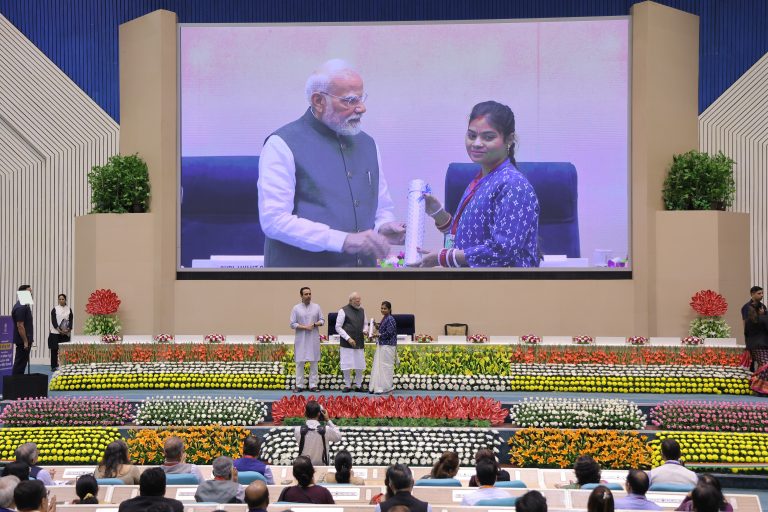
Professor Neena Gupta, a mathematician at the Indian Statistical Institute (ISI) in Kolkata, is drawing renewed national attention for her work on a long-standing problem in algebraic geometry. Her research on the Zariski Cancellation Problem, first posed in 1949, produced a landmark counterexample in 2014 and helped establish her reputation in the international mathematics community.
Gupta has also been named to TIME100 Next India 2026, in the Health and Science Innovators category, bringing fresh attention to the work of Indian researchers in fundamental science.
What is the 70-year-old Zariski Cancellation Problem?
The problem was proposed by mathematician Oscar Zariski in 1949. In simplified terms, it asks whether two mathematical structures that become equivalent after an additional dimension is added must also have been equivalent before that dimension was introduced.
The question belongs to algebraic geometry, a field that studies geometric objects using algebraic equations and polynomial structures. It is a highly technical subject, but the underlying challenge is about whether adding an extra variable can hide important differences between mathematical objects.
How Neena Gupta made the breakthrough
In 2014, Gupta demonstrated that a three-dimensional affine variety constructed by Asanuma provides a counterexample to Zariski’s question in positive characteristic. Her result showed that the expected cancellation property does not always hold in that mathematical setting.
The work was significant because it answered a fundamental question in affine algebraic geometry and opened further avenues for research in commutative algebra and related areas.
Recognition and awards
Gupta’s work has earned several major honours. She received the Shanti Swarup Bhatnagar Prize in Mathematical Sciences in 2019 and the DST-ICTP-IMU Ramanujan Prize in 2021. In 2024, she was awarded the Infosys Prize in Mathematical Sciences for her contributions to the Zariski Cancellation Problem.
Her research profile also reflects the importance of pursuing fundamental mathematics, where progress can take years and the results may not have an immediate everyday application but can reshape how a field understands its basic questions.
Why her achievement matters
Gupta’s journey highlights the contribution of Indian institutions and researchers to global science. Her work was carried out in India and demonstrates how original research from university and institute laboratories can influence international academic discussions.
Her recognition is also significant for young students, especially women considering careers in mathematics and other research disciplines. It offers a visible example of how persistence, curiosity and deep subject knowledge can lead to discoveries with lasting impact.
About Neena Gupta
Neena Gupta is a professor in the Theoretical Statistics and Mathematics Unit at the Indian Statistical Institute, Kolkata. Her research areas include commutative algebra and affine algebraic geometry.