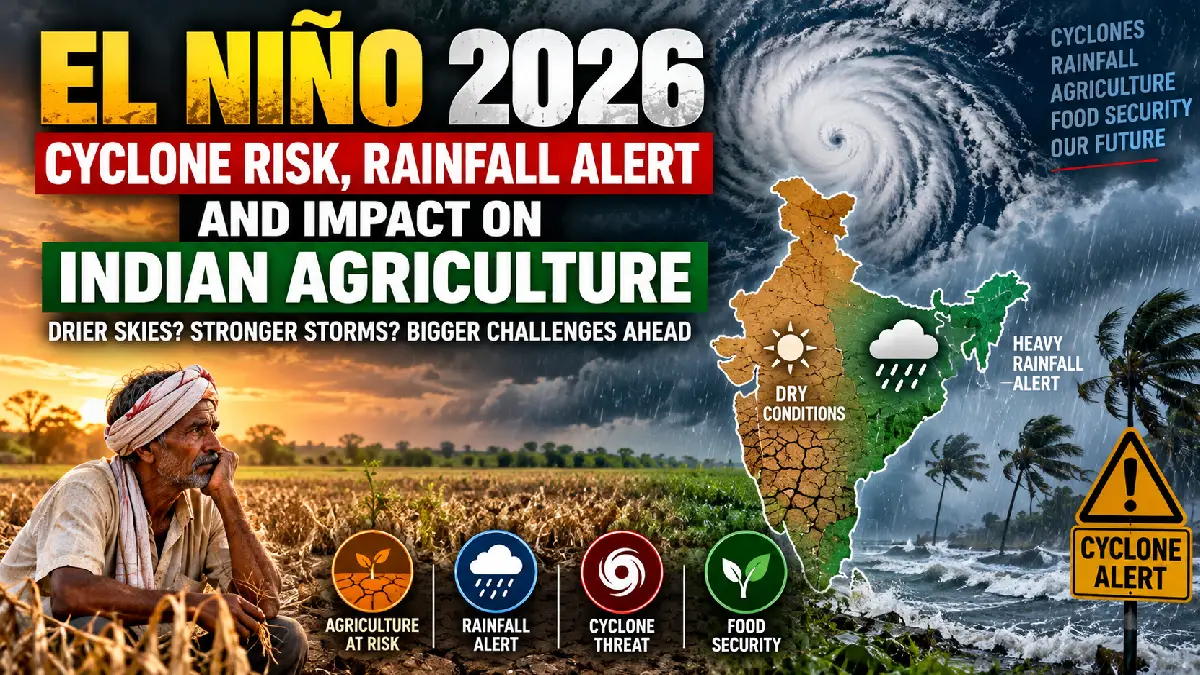
India is heading into an important weather period as a strengthening El Niño continues to influence the broader climate pattern across the Pacific and Indian Ocean. The phenomenon is raising concerns over rainfall distribution, agriculture, water availability and the possibility of extreme weather events during the post-monsoon season.
The India Meteorological Department (IMD) has been closely monitoring El Niño and other climate drivers, while recent scientific assessments suggest that the interaction between El Niño and the Indian Ocean Dipole (IOD) could produce highly variable weather across different parts of India.
El Niño and India’s Rainfall
El Niño is generally associated with weaker Indian monsoon conditions, although its impact is not identical every year. In 2026, rainfall has already been uneven, with several regions experiencing significant deficits.
The government had earlier projected 2026 southwest monsoon rainfall at around 90% of the long-period average, with a high probability of below-normal rainfall. Such conditions can affect agriculture, water resources and hydropower generation.
Recent reports indicate that dry conditions are already creating concerns for agriculture, particularly for rainfall-dependent crops. Rice production is also expected to decline significantly in 2026 amid rainfall deficits and reduced cultivated area.
What About the “17 Cyclones” Claim?
Claims circulating about 17 cyclones need to be interpreted carefully. The number should not be treated as a confirmed forecast of 17 cyclones hitting India.
Research on the Bay of Bengal shows that cyclone activity can vary considerably depending on ENSO conditions. A study covering 1995–2019 found 15 cyclones during nine El Niño years, compared with 33 during 11 La Niña years and 17 during five neutral years. This historical data does not represent a prediction for 2026.
Therefore, residents should rely on official IMD cyclone warnings rather than social-media projections or generalized seasonal numbers.
Impact on Agriculture
Agriculture remains one of the sectors most exposed to rainfall fluctuations. Rain-fed crops such as pulses, oilseeds and some cereals can be particularly vulnerable to prolonged dry spells.
The effects can also extend to food prices. Lower production can reduce market supplies and potentially increase prices, while government stocks and imports can help cushion shortages. Recent analysis has already highlighted concerns about food inflation following erratic monsoon conditions.
What Lies Ahead?
The weather outlook remains uncertain because El Niño is only one of several factors influencing India’s climate. The IOD, atmospheric circulation and regional weather systems can alter rainfall patterns substantially.
For now, the key message is preparedness rather than panic. Farmers, coastal communities and local authorities should continue monitoring IMD forecasts, cyclone alerts and agricultural advisories as conditions evolve