Updated November 27, 2026: The Union Cabinet has approved a second container terminal at Kamarajar Port in Tamil Nadu, a ₹4,288.26-crore project designed to add 2 million twenty-foot equivalent units (TEUs) of annual handling capacity. The terminal will be developed in two phases under a public-private partnership (PPP) model.
The project is intended to accommodate larger container ships and meet growing export-import demand from the Chennai–Ennore industrial region and the wider southern hinterland. The approval is not the same as a construction start: the project still needs a concession award and the subsequent implementation process.
What has the Cabinet approved?
The Cabinet Committee on Economic Affairs cleared the development of a 900-metre-long terminal on a 111-acre site at Kamarajar Port Limited. The proposed berth will be 30 metres wide, with an 18-metre design draft. It is designed to handle container vessels of up to 24,346 TEUs and 400 metres in length.
The project will follow a Design, Build, Finance, Operate and Transfer (DBFOT) structure. The detailed project cost is ₹4,288.26 crore, including GST, and the concession period is 40 years.
How the two phases will be built
- Phase I: 1.1 million TEUs of annual capacity, with an estimated PPP investment of ₹2,429.32 crore. The phase is scheduled for completion within 24 months of the award of concession.
- Phase II: An additional 0.9 million TEUs, with an estimated investment of ₹1,858.94 crore. The project plan targets full commercial operations in the 49th month.
The full construction period is planned for 48 months. Kamarajar Port will separately incur an estimated ₹450 crore for dredging. The PPP investment is to be arranged by the selected concessionaire; DD News reported that the project has no direct financial implication for the Union government.
Why Kamarajar Port needs more capacity
Kamarajar Port handled 700,639 TEUs in FY 2025–26, according to the port’s official statistics. The Cabinet briefing says the port’s existing capacity is 1.4 million TEUs and traffic is projected to reach 2.45 million TEUs by 2034. The new terminal would add 2 million TEUs of annual capacity.
KPL also handled 49.08 million tonnes of cargo and 1,008 vessels in FY 2025–26, according to its official cargo and vessel records.
The Cabinet briefing says container traffic across Indian ports reached 25.7 million TEUs in FY 2025–26, up from 17.2 million in FY 2019–20. It projects national traffic of 40 million TEUs by FY 2029–30. The figures help explain why additional deep-water capacity is being planned, although actual future traffic will depend on trade growth and shipping patterns.
Which regions could benefit?
The proposed terminal is expected to serve cargo from Tamil Nadu, Karnataka, Andhra Pradesh and the wider southern hinterland. The project documents identify industrial clusters including Chennai–Sriperumbudur–Oragadam, Hosur, Bengaluru, Sri City and Tirupati. Key cargo-generating sectors include automobiles and components, engineering goods, electronics and chemicals.
By accommodating larger mainline vessels, the terminal could improve direct shipping connections and reduce the need to route some cargo through overseas transshipment hubs. Those benefits will depend on shipping-line decisions, operating efficiency and the final concession arrangements.
What happens next?
The project is to be taken forward through a transparent global bidding process. The 24-month and 48-month construction milestones are tied to the award of the concession, so the final calendar will depend on when that award is made and the project conditions are met.
Infoflick has also covered the other major infrastructure approvals in the same Cabinet package: the ₹11,000-crore construction equipment manufacturing scheme and the ₹2,014-crore greenfield airport proposal near Silchar.
Sources and documents
- Government of India: Cabinet briefing and project details, November 25, 2026
- DD News: Cabinet approves second container terminal at Kamarajar Port
- ETInfra: Project cost, phases and operational timeline
- Moneycontrol: Project financing and port capacity details
- Kamarajar Port: Official cargo and container statistics
- Kamarajar Port: Official vessel-handling statistics
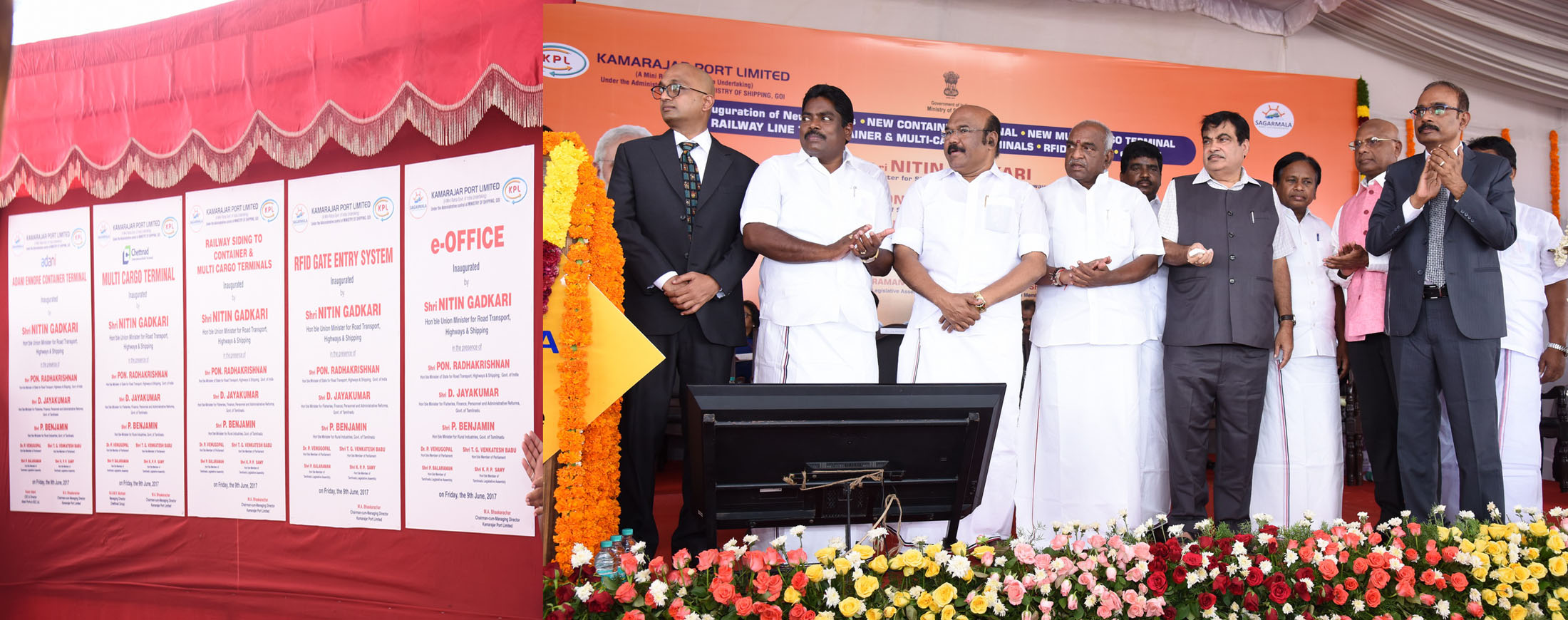
Image note: The featured photograph is an archival 2017 file image of a Kamarajar Port container-terminal inauguration. It does not depict the newly approved second terminal.