Supreme Court on Private Universities
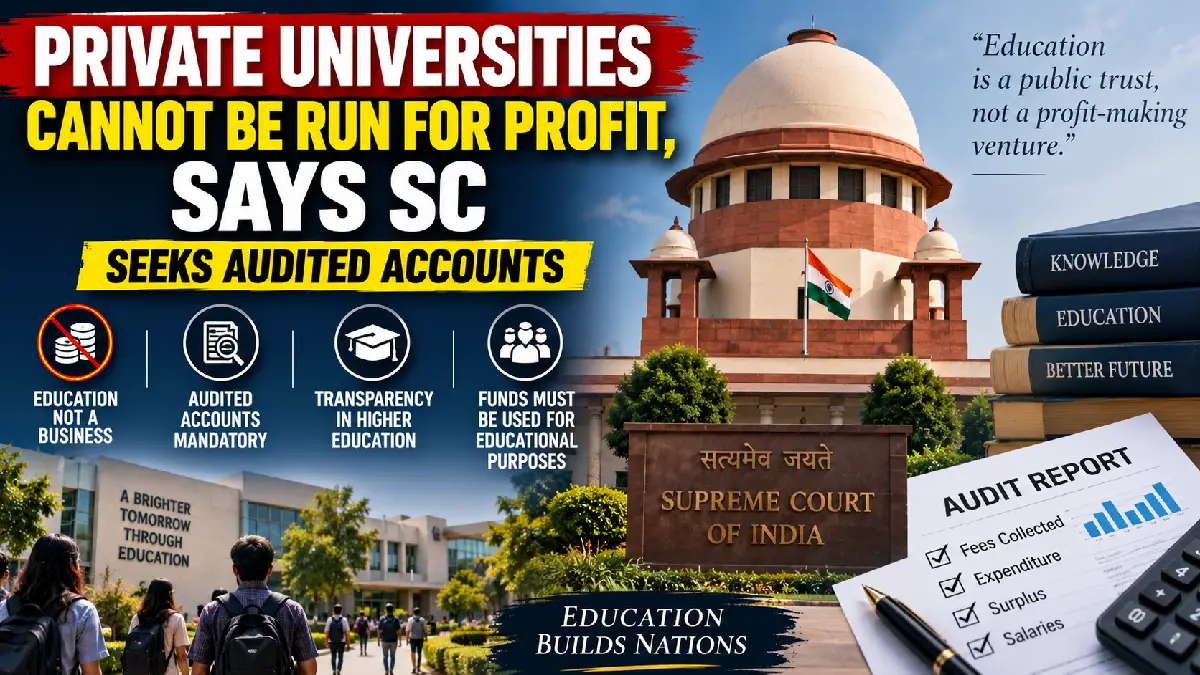
The Supreme Court has reiterated that private universities and educational institutions cannot be operated as profit-making ventures, while seeking detailed financial information to examine how funds generated through education are being used. The court has directed states and Union Territories to provide audited financial records covering areas including fee collections, expenditure, surplus income and employee salaries.
The development comes amid continuing judicial scrutiny of the financial practices of private educational institutions and the broader question of how fee income and surplus generated by universities should be utilised.
Audited Accounts Sought
According to the latest report, the Supreme Court has asked the concerned states and Union Territories to submit audited accounts containing details of the financial operations of private universities. The information is expected to provide a clearer picture of the money collected from students and how those funds are subsequently spent.
The records will include information on fees collected, expenditure, surplus generated and salaries paid to employees. Such financial disclosures can help authorities assess whether funds are being used for educational purposes and institutional development rather than being diverted for private gain.
What the Supreme Court Has Said Earlier
The latest development is consistent with the Supreme Court’s earlier rulings on the commercialisation of education. In its previous judgments, the court has held that private unaided educational institutions have autonomy in several matters, including fee structures, but that this autonomy does not permit profiteering or the charging of capitation fees.
The court has also recognised that educational institutions may generate a reasonable surplus. However, judicial decisions have stated that such surplus should be used for the development and expansion of education and the institution, rather than being treated as personal profit.
Why the Financial Details Matter
Private universities depend substantially on student fees and other sources of institutional revenue. At the same time, students and parents face concerns about rising education costs. Detailed audited accounts can therefore provide regulators with information about the relationship between fee collections, operating expenses, infrastructure investment, staff salaries and institutional surpluses.
The Supreme Court’s direction is also significant because transparency in financial management is closely connected with the regulation of higher education. Earlier rulings have emphasised that reasonable regulation can be imposed while preserving the autonomy of private educational institutions.
Focus on Transparency in Higher Education
The latest proceedings put the financial functioning of private universities under renewed scrutiny. The submission of audited accounts is expected to give the court a more detailed understanding of how educational institutions collect and utilise funds.
The Supreme Court’s position reinforces the distinction between generating a reasonable surplus for institutional purposes and profiteering from education. The detailed financial information sought from states and Union Territories will be important in determining how the regulatory framework is applied to private universities