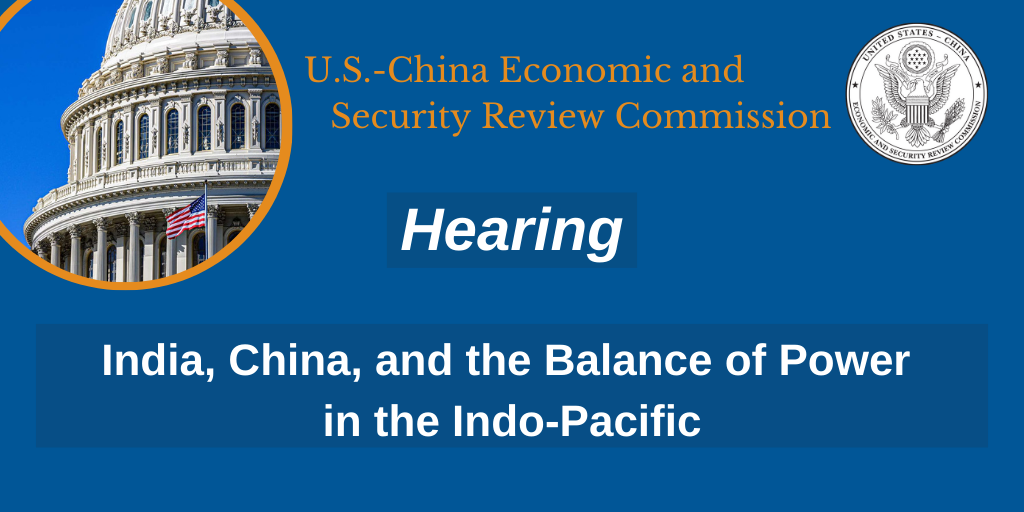
A new report by the U.S.-China Economic and Security Review Commission has warned that Beijing is applying military, economic and maritime pressure to constrain India’s growing regional influence. The commission’s 2026 Annual Report to Congress, released on November 18, identifies India as one of the few powers with the scale to influence the long-term balance of power with China.
The report, titled China’s Other Front: India and the Future of U.S. Strategy in the Indo-Pacific, argues that China’s approach towards India extends beyond the disputed Himalayan border. It includes military infrastructure development, closer defence ties with Pakistan, maritime activity in the Indian Ocean and the use of supply-chain dependence as economic leverage.
Border infrastructure remains a major concern
The commission says the unresolved Line of Actual Control remains the central fault line in China-India relations. It points to China’s expansion of airfields, railways, logistics networks and other dual-use infrastructure that could improve the speed at which the People’s Liberation Army moves personnel and equipment towards the border.
Although New Delhi and Beijing have taken steps to rebuild relations since late 2024, the report says strategic distrust remains high. The 2020 Galwan Valley clashes continue to shape India’s assessment of the security relationship.
China-Pakistan military ties add to India’s security challenge
The report also highlights China’s evolving military partnership with Pakistan. It says the relationship increases India’s concern about a possible two-front contingency, in which New Delhi could face pressure along both its western and northern borders. The commission discusses Chinese military assistance and support to Pakistan as part of Beijing’s wider regional strategy.
Economic dependence is another source of pressure
Beyond military activity, the commission identifies China’s influence over critical industrial inputs, technology and manufacturing equipment as an important source of leverage. It describes restrictions affecting supply chains, electronics manufacturing, pharmaceuticals and battery technology. India’s dependence on some Chinese components and machinery creates challenges as the country seeks to expand domestic manufacturing.
What the report says about India-US cooperation
The commission recommends deeper cooperation between Washington and New Delhi in areas such as defence, intelligence sharing, maritime awareness, technology and manufacturing. It also acknowledges that India follows a policy of strategic autonomy and will make decisions based on its own national interests rather than automatically aligning with US priorities.
The report is an assessment prepared for the US Congress by an independent commission. It should not be interpreted as a joint policy statement by the governments of the United States and India.
Why the report matters
The findings underline how India’s security and economic interests are increasingly linked to developments across the Indo-Pacific. Border stability, access to critical technologies, supply-chain resilience and maritime security are likely to remain important issues in India’s engagement with both China and the United States.
Source
U.S.-China Economic and Security Review Commission – 2026 Annual Report, Chapter 3.
Infoflick note: This article summarises the commission’s assessment. The report’s conclusions and recommendations represent the commission’s analysis and are not official statements by the Indian government.