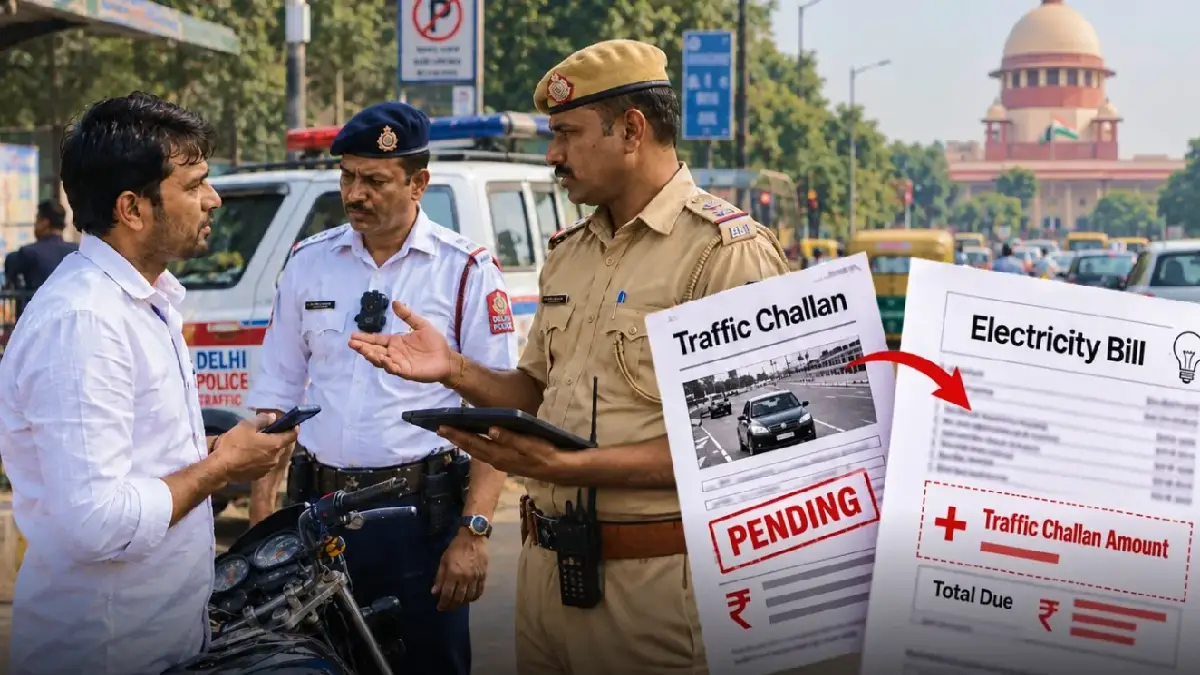
The Supreme Court of India has suggested exploring stronger mechanisms to recover unpaid traffic e-challans, including the possibility of linking outstanding traffic fines with electricity bills. The suggestion came during a hearing on road safety and electronic enforcement of traffic violations on September 28, 2026.
The development has drawn attention because of the large amount involved. According to information placed before the Supreme Court, states and Union Territories have around ₹45,000 crore in e-challan dues to recover, while approximately ₹25,000 crore has already been recovered. This indicates that more than ₹20,000 crore remains outstanding.
Supreme Court Suggests Electricity Bill Link
During the hearing, Justice J.B. Pardiwala and Justice K.V. Viswanathan discussed ways to improve recovery of traffic fines. The bench observed that simply issuing thousands or lakhs of e-challans is not enough if the fines are not ultimately collected.
One of the ideas discussed was adding unpaid traffic challans to electricity dues. The suggestion was aimed at finding a practical recovery mechanism by connecting pending traffic penalties with an existing household utility payment system.
However, it is important to note that the electricity-bill proposal is currently a suggestion discussed during the hearing, not a nationwide rule or direction that has already come into force. Any such system would require consideration and implementation by the relevant authorities.
Other Measures Discussed by the Court
The Supreme Court also discussed several other possible measures for dealing with vehicles and motorists who have long-pending traffic challans.
These include restricting the renewal of vehicle registration certificates, preventing the issuance of duplicate registration documents and stopping ownership transfers until outstanding fines are cleared.
The bench also considered measures involving vehicle fitness certificates and Pollution Under Control (PUC) certificates. Authorities could potentially restrict these services for vehicles carrying unpaid challans.
Another proposal involved using the Parivahan system to identify or blacklist vehicles with outstanding challans. The court also discussed possible restrictions on driving licence renewals and random checks of vehicles to identify persistent defaulters.
Why the Issue Matters
The discussion highlights a wider challenge facing India’s digital traffic enforcement system. E-challans allow authorities to record traffic violations electronically, but collecting the resulting fines can be more difficult.
The Supreme Court is examining these issues as part of a long-running road-safety public interest litigation filed in 2012. The court has also sought a detailed assessment of the implementation of earlier road-safety directions.
For motorists, the immediate takeaway is that unpaid challans could face stronger recovery measures in the future, but the proposed electricity-bill linkage has not yet become a general enforcement rule. Vehicle owners should check their pending e-challans through official government channels and clear legitimate dues where applicable.